
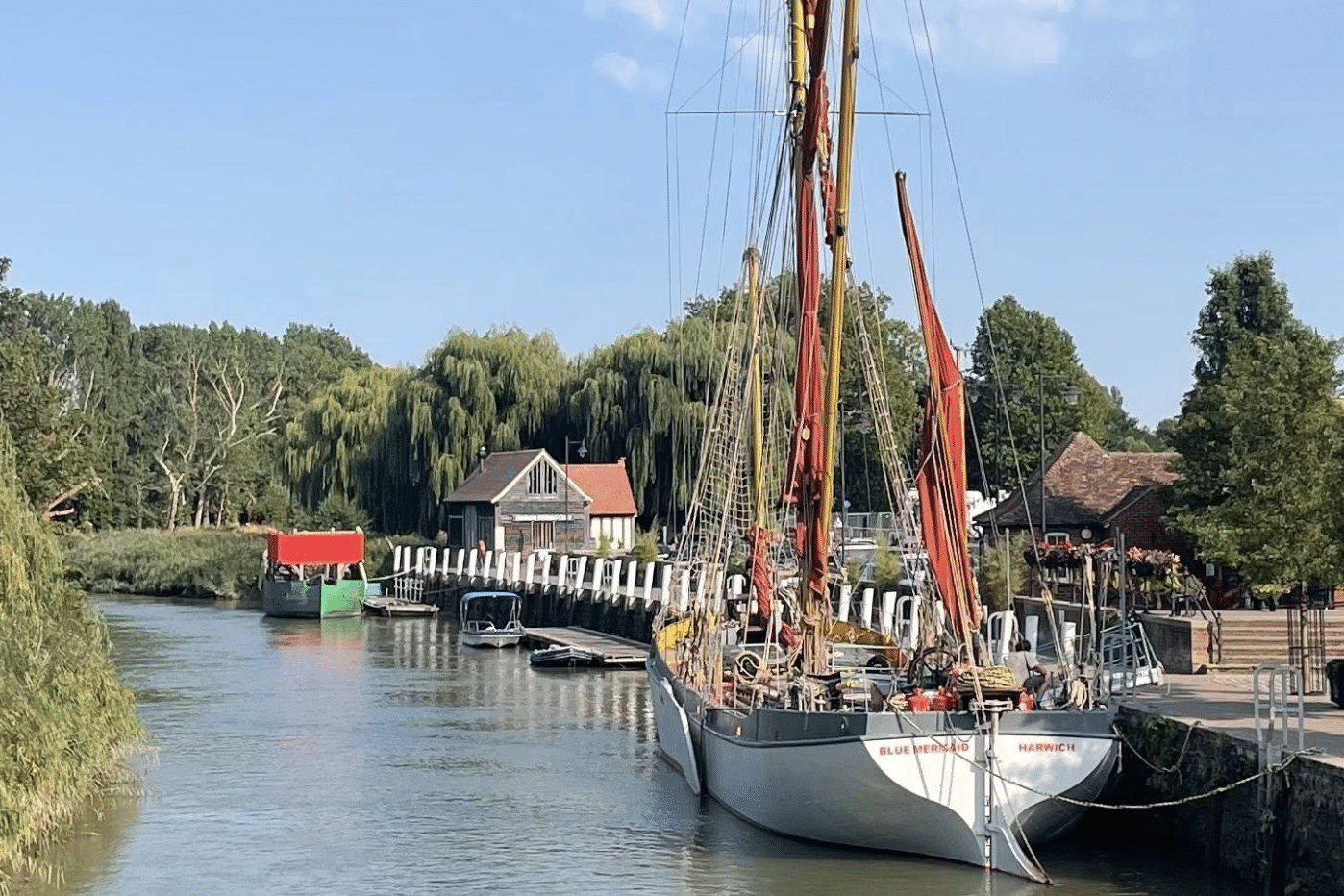
Blue Mermaid Visits Sandwich
by Richard Titchener
Towards the end of Blue Mermaid’s tour for the Wind, Tide & Oar film in 2024, she visited Ramsgate and we met Nick Gray, founder of Sandwich Heritage Harbour Group then working towards charity status. He invited us to visit Sandwich, oddly enough named as the southern extremity of her area of operation in the Cargo Loadline Exemption. It seemed like the right thing to do, and mental notes were made to keep in touch. After the exertions of the film tour (11 ports between Lowestoft and Ramsgate) the next year was one of consolidation for us. Meanwhile, the Heritage Harbour group obtained charitable status. We started to talk seriously about a visit in 2026. So the arrangements have been going on for some time. We visited Sandwich in December 2025 by car and started to scope out what would be needed. For this was not to be the most straightforward of visits, although having done it we hope others will follow.
Why not so straightforward? Apart from anything else, Blue Mermaid does not have an engine and towage had to be arranged. On two previous visits to Ramsgate Paul Cannon had been helpful in this respect and it turned out he also ran the seal-spotting boat on the Stour, so he seemed a likely source of support and that indeed proved to be the case. Nevertheless, to do it justice we would need to take three weeks of the sailing schedule, and it would need funding. Being a sail training organisation, logically it would be best to find voyage crew in and out and arrange funding for them while asking the Heritage Harbour to cover the time spent alongside.
In the Middle Ages, Sandwich was one of the most important ports in the country and for a time the most important. It sat on a wide estuary which separated the Isle of Thanet from the mainland, the Wantsum Channel, coming out to the north at Reculver where the Romans built a major fort to protect it. Near Sandwich, on an island in the estuary, they built another major fort at Richborough. Kings used Sandwich as their favoured port of entry and departure. One of the five major Cinque Ports, it provided the crown with ships in times of need. Its first Mayor was appointed in 1226, another reason to visit as 2026 is the 800th anniversary. I am fond of wearing a hat given me by Michael Mainelli when he was Lord Mayor of London in 2024 and it has his number on it, but that is only 695, meaning Sandwich knocks it into a cocked version.
The stone for Canterbury Cathedral came by water from France and reached close to the city, near Fordwich, a Cinque Port Limb of the Head Port of Sandwich. Sarre, on the northern branch of the estuary towards Reculver, was another. Brightlingsea also became a Liberty of Sandwich Cinque Port, the only such thing on the east coast. This seems odd, but if we remember how important the Yarmouth Herring Fair was in those days, it is perhaps fitting that a fine haven like the Colne, one of Henry VIIIth’s favourites, was chosen.
Much has changed since those times. Gradually the Stonar Spit moved south from the north side of Pegwell Bay, eventually close enough to make a swingbridge possible at Sandwich in 1755 where a ferry had been from at least 1127. By the time the bridge was built, the estuary had reduced considerably, despite many petitions to the crown to help keep it open. But small craft could still make passage through the Wantsum Channel and were encouraged to draw rakes astern to help keep it clear. To no avail: the twin effects of siltation and embankment for gain eventually led to the channel being closed by the seawall we now see as we pass Reculver.
The link with Brightlingsea meant that there remains a strong mainly ceremonial attachment between the two ports. The Mayor of Sandwich is the Mayor of Brightlingsea, having a Deputy on the spot, a role rejuvenated in the nineteenth century by Squire Bateman (he of Bateman’s Tower, the leaning tower of Brightlingsea on the seafront). He provided the Deputy with a silver chain of office which has the largest cut opal in the world. The Deputy is confirmed by Freemen of the Cinque Port Liberty each year at Choosing Day and both ports have active social and community calendars.

The Deputy in 2026 is Tony Linton, who has been a tower of strength in helping pull together a group of young people from the town to crew the Blue Mermaid to Sandwich, and welcome with him the returning group from the Sandwich Scout Troop. While these arrangements were being made by supporters in both places, the logistics started to come together.
There are many photos of sailing ships and barges at Sandwich quay in the 19th and early 20th centuries. Near the entrance, Port Richborough was built by military engineers in a few months during WW1 to supply our troops in France, and the entrance was dredged for train ferries from the steam-powered ramps by enormous marshalling yards, now hidden under trees and by industrial estates. After the war, one of these ramps went to Harwich for the Great Eastern Railway until train ferries stopped in the nineteen-seventies. The line that disappears under the new Trinity House workshop at Harwich is the one that we watched wagons run along onto the pier and ships when we were kids. At Sandwich, there was Felton’s shipyard a little down river from the quay where a nearby gas works was supplied by water. The story of the shipyard is provided in a book by Margaret Simmons who visited us during our time there. There was adequate space to turn vessels bigger than sailing barges, although there is a photo of a schooner that got it wrong and hung up on both sides above the bridge. The last cargo was discharged at Sandwich Town Quay in 1966, in a sailing barge piloted by Paul Cannon’s father, though we do not know which one. There will be a ledger somewhere in the loft of the town hall but it is not on show. After that, an oiler barge went through the bridge for some years longer, but that too stopped. Many will remember the cooling towers of Richborough power station not far away, visible on a clear day from north Essex. It was built to utilise Kentish coal from nearby pits and as they ceased working was given over to a mixture of liquified fuel that came in by sea to berths below the town and was said to pollute the local area, so much so the power company (then belonging to us) settled out of court and closed the power station. There is a small power plant in the industrial estate by the river right next to wharves well capable of use, but it is supplied by road with biomass, not unlike the much larger Drax station itself near coal deposits. The industrial estate was the site of the Pfizer works that manufactured Viagra before retrenchment to the US meant its closure. With the reduction in traffic, siltation continued as it so often does, aided by the effect of new and bountiful reed beds helping to gather silt in ever wider and higher hillocks.
The visit by the barge needed the support of a number of people, not least the people who funded it. Sandwich Heritage Harbour helped and obtained support via the Town Council from the Georgina Maddox Fund. She had been a well-liked supporter of heritage in the town and left a significant sum to support its future. The project was also supported by the Christopher and Henry Oldfield Trust, Brightlingsea Cinque Port Liberty, the voyage crews from Sandwich Scouts and Brightlingsea Teens to Twenties Group, and a number of local individuals making donations before and during the visit. We were able to put on an excellent exhibition about sailing barges thanks to displays borrowed from the Thames Sailing Barge Trust and the Society for Sailing Barge Research.
I visited shortly before we were due to make the passage and went down river with Harbourmaster Ian Broughton who showed where trees had been significantly pruned back as they obstructed the channel below the quayside. This had cost several thousand pounds. The Harbour Commissioners had been instrumental in making this happen and in preparing a turning area as well, for the usual one above the bridge was too short for the barge. It was soon apparent she was the largest vessel to visit for thirty years and perhaps longer. The replica of John Cabot’s Matthew visited but she is some 65 feet and with her rudder the barge needs 95 feet to swing. If the river were straight and the banks clear of encumbrance then the process would be easier, but the upper reaches approaching Sandwich are very circuitous and the banks are overgrown by reeds one side with the other taken by marina berths naturally using the available space for (in some cases) quite large vessels. These reeds are recent newcomers but once there, each individual stalk seems to have considerable environmental protection as was discovered when a request was made to remove a small outcrop of mud that had collapsed from a dilapidated quay itself shrouded in reeds. A long email from the regulator required reeds to be cut manually leaving the stalks and specialist wildlife surveys to be taken before anything was done. Time ran out, but on the day in question thankfully the tide was sufficient to adequately cover the area and the wildlife was saved any searching questions.

Eventually the 10th August came round and we took the barge to Brightlingsea and were ready when the St Osyth Boatyard tug came to tow the barge up the creek the following morning. Alongside the hammerhead with kind permission from the Harbour Master, we welcomed aboard a group of young people and staff from the St James Church Teens to Twenties Group, seen off by the Deputy and the Mayor of Sandwich who happened to be visiting that day. With a passage to make and three days to complete it the first afternoon was devoted to learning about how the barge works and settling in, with a trip to the beach inside Colne Point and an early night. Tows were arranged for the Friday day tide from Pegwell Bay so there was no time for dawdling. Also, there had been a period of easterly weather, sometimes with strong winds and there was every reason to think we might need to find an anchorage in the lower reaches of the Stour if it were not fit to anchor in the Bay. As things turned out, the forecast soon gave moderating winds from Thursday and we had worried unnecessarily. The early start Wednesday was initially against a moderate north-easterly, just a topsail breeze, out to the Spitway, and a fine and fast run upSwin. So fast in fact, we were off Whitstable approaches well before high water and settled down to a slog against the now easterly breeze along the north Kent shore. Sunny it certainly was and a fine sail, but it soon became evident there would be no reduction in the wind until too late for a settled anchorage along the exposed shore. The decision was made in the late afternoon to run back and find an anchorage west of Whitstable Street. Once here, the strength of the ebb was much-reduced having little head of water to the west of us, and the breaking water on the Street took the tops off the waves as well, giving a reasonable night’s sleep.
Thursday dawned quieter and still sunny, with a pleasant sea breeze forecast for around high water. It arrived late morning right on cue, and we settled down to a long but wonderful beat with both jibs along the sun-drenched North Kent Riviera. By the time we reached Margate the crew was a well-oiled operation. A small ship we had seen leave Whitstable the previous day was anchored in Margate Roads with others. One of the Adventures Offshore boats was anchored close under the Margate Hook Sand, waiting for a fair tide with crew below out of the strong sun with a sail rigged as a ventilator above the forehatch. The fine easterly breeze was forecast to die with the sun and indeed it did, but a little early. Having brought the ebb along the coast it helpfully continued to run to the south for another four hours so the remaining five miles was helpfully not too far with favourable conditions. Off North Foreland we were left with only cats paws of wind and the sweeps were utilised until it became clear the wind was not going to return. For the final hour the trusty Tohatsu was engaged on the quarter while we ate dinner, bringing up by the Sandwich Approach buoy as the sun set. With another warm evening, the lights along Ramsgate waterfront and a mirror-like surface, we mused this might have been St Tropez.

In the morning the bowsprit was cleared and steeved up and anchor cable shortened ready for Paul in Silver Lining late morning to tow into the river. The seals resting along the northern bank hardly stirred as we passed.

A short way inside Tom Lash of Richborough Marine arrived in his Thames tosher tug Greenwich with a full and helpful crew. Before the river narrowed, a spot was found to push Blue Mermaid into the reeds, transfer tows and wait for the tide to rise enough to proceed. This was finely judged by expert local knowledge. It was necessary to pass the narrowest parts near enough to high water for the flow to have reduced for safety, for there to be enough water to go into the reeds where necessary to avoid moored boats, yet soon enough to be able to swing the barge below the quay before the ebb set in. Greenwich now took the bow and Silver Lining the stern to act as brake and additional steering around the tight bends, with a third smaller boat available at tight spots. Ian Broughton had managed to have several boats moved in the narrowest parts, and we were grateful to the yards and owners who made this possible. Thanks to all. Diggory climbed aloft to take a photo of the process. It looks like there is barely room for the barge and that is indeed true, but there was. It had been a condition of insurance to obtain large pneumatic fenders and these were handled expertly by two of Tom’s staff although only they came into contact and even that was minimal thanks to excellent towage.
The swing was accomplished in a culvert providing just that little bit of extra room and later inspection showed the rudder had not touched the opposite bank. It was slack water and from there we were towed sternfirst past the cut-back trees and around the last corner to be met by a welcoming party standing on the stern castle of the replica ship at the Medieval Centre (which has a working forge, somewhat amazingly). And then we were alongside safely nestling in the bosom of the town.
And what a lovely and welcoming town it is. Over the week and a half of the visit and open to the public most days after a civic reception shortly after arrival, we welcomed six hundred visitors aboard. Some said it would be more had not the swing bridge been closed to traffic after a lorry damaged the parapet. The lorry was one of a liquid waste fleet linking parts of the local sewage system as a pipe was leaking. For the first part of our visit, until the pipes were repaired, there was a constant movement of lorries before peace returned. A wag said we had missed an available cargo opportunity. People were unused to seeing something as large as Blue Mermaid at the quay and many asked how she had got there and how was it turned round, for now the channel here is not wide enough to swing though we lay afloat at all times. Indeed, not far down river the leadline revealed a depth of 18 feet.

Our friends at the Heritage Harbour made us very welcome. Apart from public openings, the barge hosted evening events – American swing dancing, shanty and literary evenings. The many visitors included Catherine Holt from Dover Museums who had sailed with us as a trainee with the Shipshape Heritage Training Partnership some years ago. We also met several of the scouts who were due to sail back to Brightlingsea the following week.

“Do you remember me?” said a young man on the quay one afternoon, and it was Ben Ricini, a local Man of Kent who had spent several happy summers sailing with our Youth Sailing Scheme in his teens. Now much older, he mentioned he had just been promoted to First Officer of Cunard’s Queen Elizabeth. Windy weather passed through while we were in the shelter of the town and there was a settled and light easterly by the time we departed, after a pleasant debrief and dinner with the Heritage Harbour Trust.

On 26th the tugs returned a little before high water. So the tow was helped by the flow through the narrowest parts. As the river broadened at Richborough, the tugs swapped round and we said goodbye to the Greenwich and Silver Lining took us down the approach channel before returning to her berth at Ramsgate. Suddenly the quiet reverie of the passage down river was replaced by a turn to windward in glorious sunshine. The seals were still there, and I counted close to 100 in a thriving colony opposite a sand spit literally heaving with birdlife. Both jibs were set before we passed Ramsgate to fetch along the coast, again with a fair tide, so important to getting round this corner. Wind over tide along the north Kent coast made for some unpleasant feelings among one or two crew, who heartily wished the Wantsum Channel was still there to cut off the corner to Reculver, by which point the tide was fair and the last of several gybes was completed before anchorage off Tankerton Slopes for the night.
Thursday dawned calm providing a chance to visit Whitstable before the sea breeze kicked in and we scrambled under way shortly after the midday high water and made our way north. SB Greta was out for the day visiting the Maunsel Forts, and SB Mirosa was crossing the Middle Sand on her way back from the annual holiday to the Suffolk Rivers. The breeze held as it backed southerly after a fetch into the Swin and low water was made not far from the site of the wreck of the original Blue Mermaid on the other, northern Middle Sand close to where the West Hook Middle buoy used to be. It was dusk at the Spitway and lights were trimmed and set to take us over the tail of the Knoll, the Scouts steering well, to bring us to anchor in home waters at Weymarks Bradwell. With a day in hand before arrangements to visit Brightlingsea, there was time to sail up the home river to spend the night at Osea before dropping down again Saturday to the Colne with a fair strong wind. SB Thistle passed inbound on the way back from Clacton Airshow.
Sunday the yard tug returned and took us back to the hammerhead and a welcome from the Deputy and several of the outward crew who joined us for a barbecue at the top of the Hard, cooked by Olympic sailor Robert White. A ship was due, meaning the hammerhead had to be clear, so the departure was before high water. We returned to the buoy at Heybridge on the night tide by which time the Scouts were home in Sandwich with their minibus, which they had wisely left at Brightlingsea.

It all seems a long time ago, separated as we are now by further local charters and preparing to unrig at the end of the season. Having grown up in Brightlingsea and learning as a child so much of the history of the connection through the Cinque Ports, it was wonderful to be part of this project to link the two communities. A repeat is being actively discussed for the year after next, and work has started at Sandwich to make possible visits by other heritage vessels. It is a truly worthwhile effort to reach an historic and friendly place. Smaller vessels should contact the Harbourmaster and arrange a berth; larger ones approaching the size of a barge will likely need a boat on the bow passing the narrow parts for which local knowledge is essential and is available.
Postscript: while laying the barge up at Heybridge Basin long after returning, local worthy Derek Fox told of his boyhood at sandwich and exploits afloat on the Stour in small boats. He remembered the last barge to visit as being the Ardeer in 1966, not by then in trade. Hence the last timber freight might have been in a motor barge, and there is a photo in the Bell at Sandwich of a small LRTC barge, possibly the Naughton at the quay head up and empty in that era.