
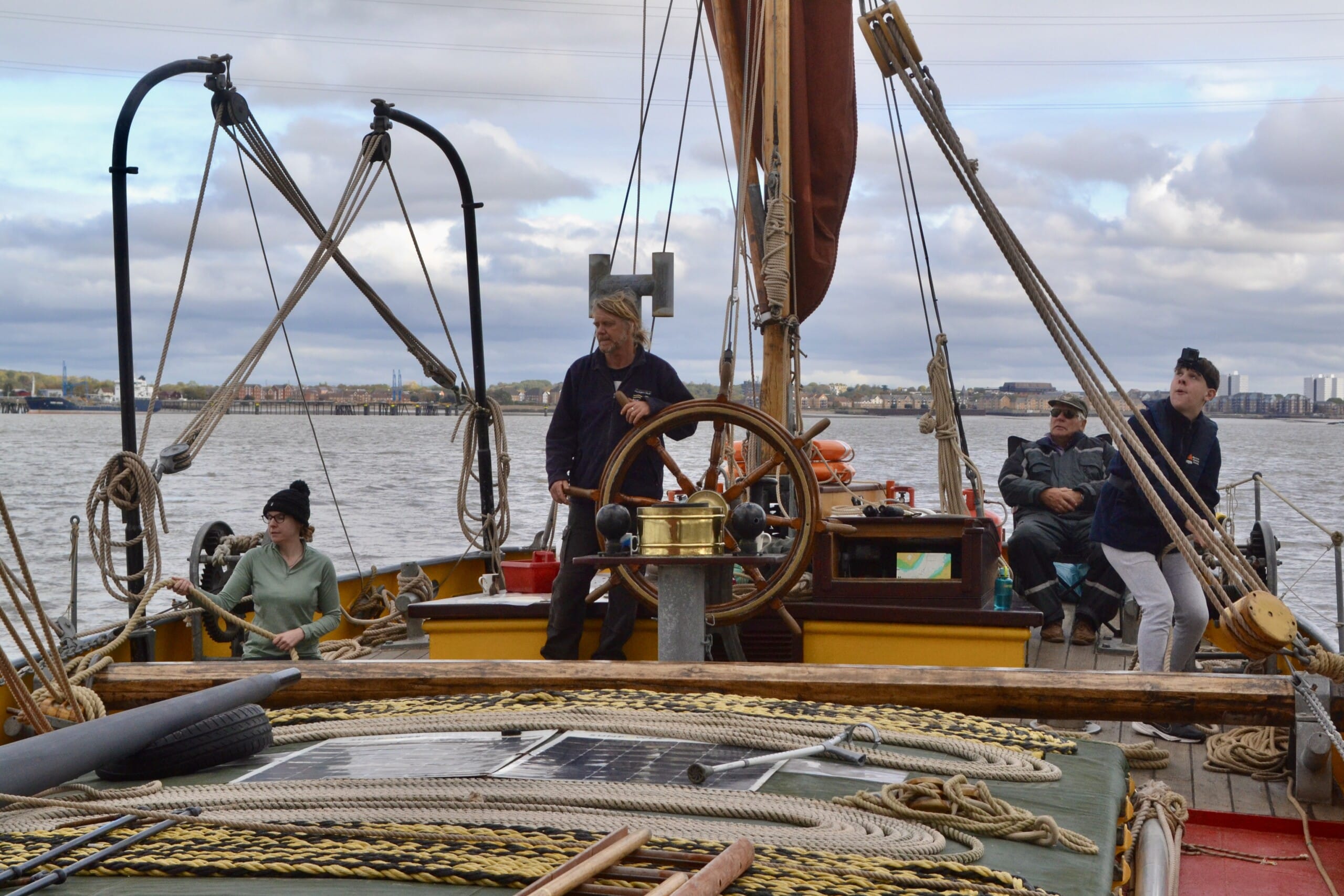
A New Spar for ‘Cutty Sark’
Part 1: to London!
[Photo Credit: John Wheeler]
Sea-Change was partnered with Cutty Sark during the Shipshape Heritage Training Partnership run by National Historic Ships. This led to a team from the ship and Royal Museums Greenwich sailing with Blue Mermaid in 2022 on a passage from Maldon to Pin Mill, the most memorable part among many being putting our 28 feet sweeps to good use in the calm at Bradwell on the second day. This is the kind of thing the Cutty Sark’s boats would have been used for in similar conditions to avoid obstructions in the South China Sea although I am not sure they would have done it for four miles as the modern team did with gusto and good humour. The breeze filled in nicely off Colne Point and took us into the anchorage off Brightlingsea.
In fact, the relationship with sailing barges started years before then. Most people who know anything about the ship at all know she was saved with the help of Prince Phillip and the second curator of the Maritime Museum, Frank Carr, but fewer know he was also a founding member of the Thames Barge Sailing Club as it was then known in 1948 at formation, and now as the Thames Sailing Barge Club. The subtle alteration of the different meaning of the order of these words is interesting. Frank was a barge enthusiast writing Sailing Barges, still the bible for our fraternity, and started a relationship with the Club/Trust that continues in the annual trip for RMG trustees and friends. And the current Director keeps that tradition alive.
To cap it all, as Cutty Sark was approaching her reopening after the cleansing fire and her suspension, the contract to restore her rig was awarded to T S Rigging of Maldon, who subsequently rigged Blue Mermaid. I say “cleansing” because it focussed minds away from alchemical projects like turning rust into metal towards making the ship look right for the Jubilee. Just after the fire a few of us who had supported Charles Harker’s campaign to send the ship to sea were treated to a tour by project manager Maldwyn Drummond. The stern nameboard section was away for repair and not affected by the fire. Otherwise all that was visible was the iron structure. Hunching low on the quarter there was an uninterrupted view of the most amazing sheer and the rise of the bow. I sat a moment and imagined her thrashing to windward scuppers awash. We all marvel at the bottom now visible above the function suite that the drydock has become, but the view I saw that day was one of the most inspiring I have seen. Charles lost his battle and the ship was suspended. We must await a more enlightened generation to build a clipper ship for the nation and send her to sea.
Through T S Rigging, Sea-Change was able to attend the opening ceremony in 2012 with a group of schoolchildren from Harlow who crewed SB Reminder to Greenwich and walked onto the deck of the clipper as the last of the VIPs left, a great honour they thoroughly enjoyed. It was a wet day and it did not go unnoticed the rain stopped as Queen Elizabeth alighted her limo and started again as she departed, affirming if affirmation is needed God is English or was that day.
TS has recently had Kevin Finch and team build a replacement mizzen royal yard at Maldon and asked if Blue Mermaid could deliver it. This came conveniently at the end of our sailing season with young people and vulnerable adults, so we said a hearty yes and waited for the yard to be ready. By then the barge was covered in weed and barnacles so Jim Dines, who runs Downs Road Boatyard in Maldon where both TS and Sea-Change are based, kindly went to the trouble of clearing the dry dock so she could be clean for the trip to London. A dirty barge is not only slow but is reluctant to manoeuvre properly so we were very grateful. In dock the 32 feet spar was craned onto the hatch top and secured along with its metalwork.
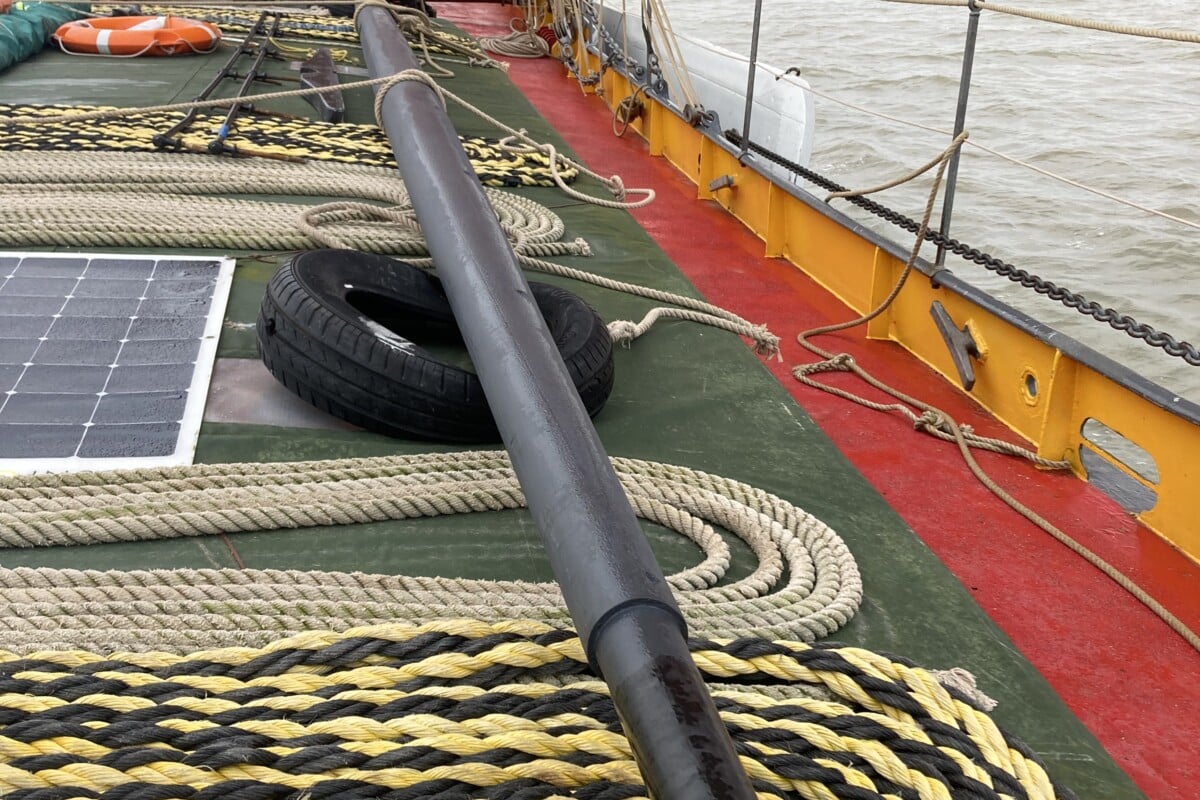
So it was that three of the Cutty Sark’s self-funding volunteers and a trainee who managed to negotiate time from school joined Blue Mermaid on her mooring at Heybridge on the Saturday prior to the planned delivery Tuesday 14th October. Plenty of time was allowed because of a forecast for light winds. The wind was indeed light from the east, a headwind, and high-water was late afternoon so it was dark well before we anchored inside the Bench Head buoy at the mouth of the Blackwater at suppertime that night, wondering if we had made enough progress to reach the tidal gate at the Spitway for low water at 1000 the next morning. As it turned out, we need not have worried. A clean barge needed little urging from the light northerly and by mustering at 0600 Blue Mermaid was well past the gate and near the Maplin Middle before the tide turned in her favour. She passed within a few hundred yards of the site of the wreck of the original Blue Mermaid lost with her crew to a magnetic mine on the north slope of the Middle Sand in 1941.
Excellent progress was made although the wind fell fickle after Southend. As it did, we stayed high into the bay and popped out at the Chapman having stayed safely clear of the deepwater channel. Even so the Chapman buoy had a magnetic attraction and required avoiding action with a burst of outboard to keep us clear. Dick Durham tells of Cambria meeting a buoy when driving down Sea Reach in the sixties and of how he had to walk the length of Southend Pier searching a late-night petrol station to feed her salvage pump as a result.
As Sea Reach narrowed, the barge was converted to staysail rig as her crew pondered where she would make high water; in the Muckings or as far as Grays. This requires holding the steeved up bowsprit on the longstay and its shrouds and a safety preventer so the jibstay can be pulled clear so as not to impede the staysail set to the stem. Blue Mermaid has both jibstay and traveller so as to teach both methods of setting a jib. Passing Stanford-le-Hope where Joseph Conrad once lived we recalled how his narrator Marlow ruminated at anchor in the Lower Hope that the river might take him to another far-distant as he introduced Heart of Darkness among others. Our lesser objective of Grays looked achievable as there was over an hour of flood left.
Indeed it was, enabling the boat to pick up another trainee from the excellent all tide causeway at Thurrock Yacht Club. Our anchorage was near the Black Shelf buoy so named after the rocky shallows guarding the approach to Grays that caught a dredger unawares; she struck and sank. There are now three navigation buoys in the vicinity to guard against a repeat. No doubt these assist the masters of ships in discerning the edges of the hatched lines denoting the fairway on their charts and equipment. Mother nature has no such help and her tides follow a different set of urges flowing furiously and threatening to catch sailing vessels. As electronic aids improve it is odd to see new buoys appear.
A lunchtime low water gave a more leisurely muster Monday with a chance to watch the river busy with traffic. One such was a medium-sized bulk carrier with two Flettner rotors. This idea was tried in the middle of the last century but failed to catch on. Rotating cylinders cut a ship’s fuel requirement by harnessing natural forces. Originally the idea harked back to the comparatively recent demise of ocean-going sail. Now it results from a need to reduce carbon emissions and the immense pollution from shipping using heavy oil offshore. Recently the Port of London Authority reissued Blue Mermaid’s Gold Certificate under its Thames Green Scheme. As Sea-Change offsets the tiny amount of residual emissions from the outboard, heating and cooking with the excellent Yacht Carbon Offset, she is carbon neutral long before the 2050 target. Available for carrying 115 tons of bagged or palletised freight, her load line can take four lorries off the road. We mulled this over as we passed the building sites on the length of the Thames almost all supplied by road.
A light north-easterly enabled departure a while before low water. Across the river at Broadness, could be discerned the hull and gear of the Lady Jean alas now sunk in the nearby creek awaiting her fate as plans for a retail and leisure development threaten one of the last green open spaces in the area. One of the Cutty Sark volunteers had attended HMS Worcester at Greenhythe only shortly after the clipper had been towed from there to Greenwich in 1952.
As the anchorages beyond Crayfordness are limited to short periods it was necessary to obtain permission to lay longer at Erith. We could have reached Greenwich a day early but had towage booked so stopped as planned. Erith is a fine anchorage if you are bound up or down. The flats give a good shelter from the prevailing southwesterly and the scrapyard removes the need for an alarm clock. The Thames Barge Matches used to start and finish here as did the 2012 match did so as to celebrate the history. The Royal Corinthian Yacht Club was based here before moving to Port Victoria on the Isle of Grain before settling at Burnham. Ashore there are shops and an excellent swimming pool as well as the welcoming arms of Erith Yacht Club where Bob Roberts recruited crew for Cambria.
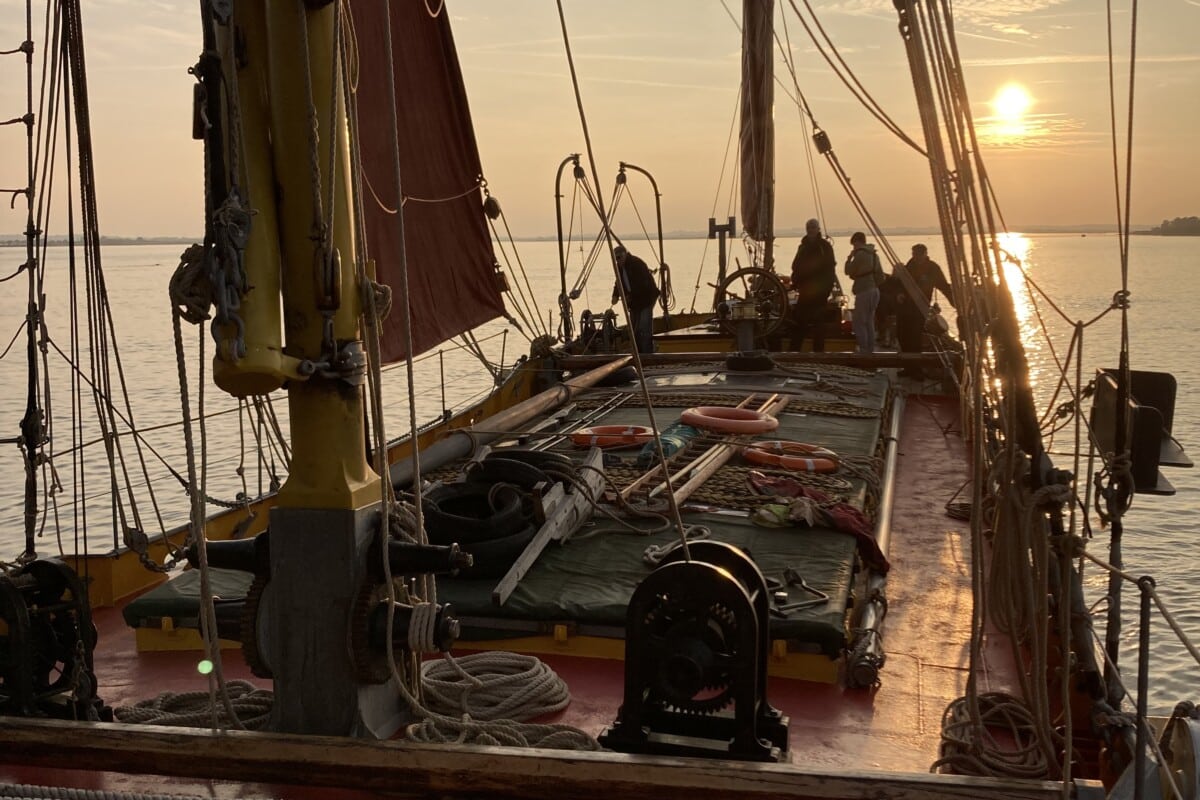
Getting under way with some ebb still to run, we warned VTS we would need the whole river in Erith Reach due to the wind direction. There was nothing about. Honour was maintained by the instruction to navigate to starboard and a fine sail was had with staysail against the last of the tide. One or two people on a motor barge on Erith Mill rested a moment to watch the barge go past. From Jenningtree Point we fetched and met the tug Alfie waiting in Barking Reach with Chris Livett himself in command for the remainder of our passage to reach Greenwich Pier at 1545. Chris has been instrumental in making our last few visits to the London There we were met by Tom a very helpful piermaster and the team from TS Rigging who took the spar onto the pier for the night and moved it to the ship early the next morning before the commuter rush.
You can read about the return passage in Part 2: Home to Maldon!