
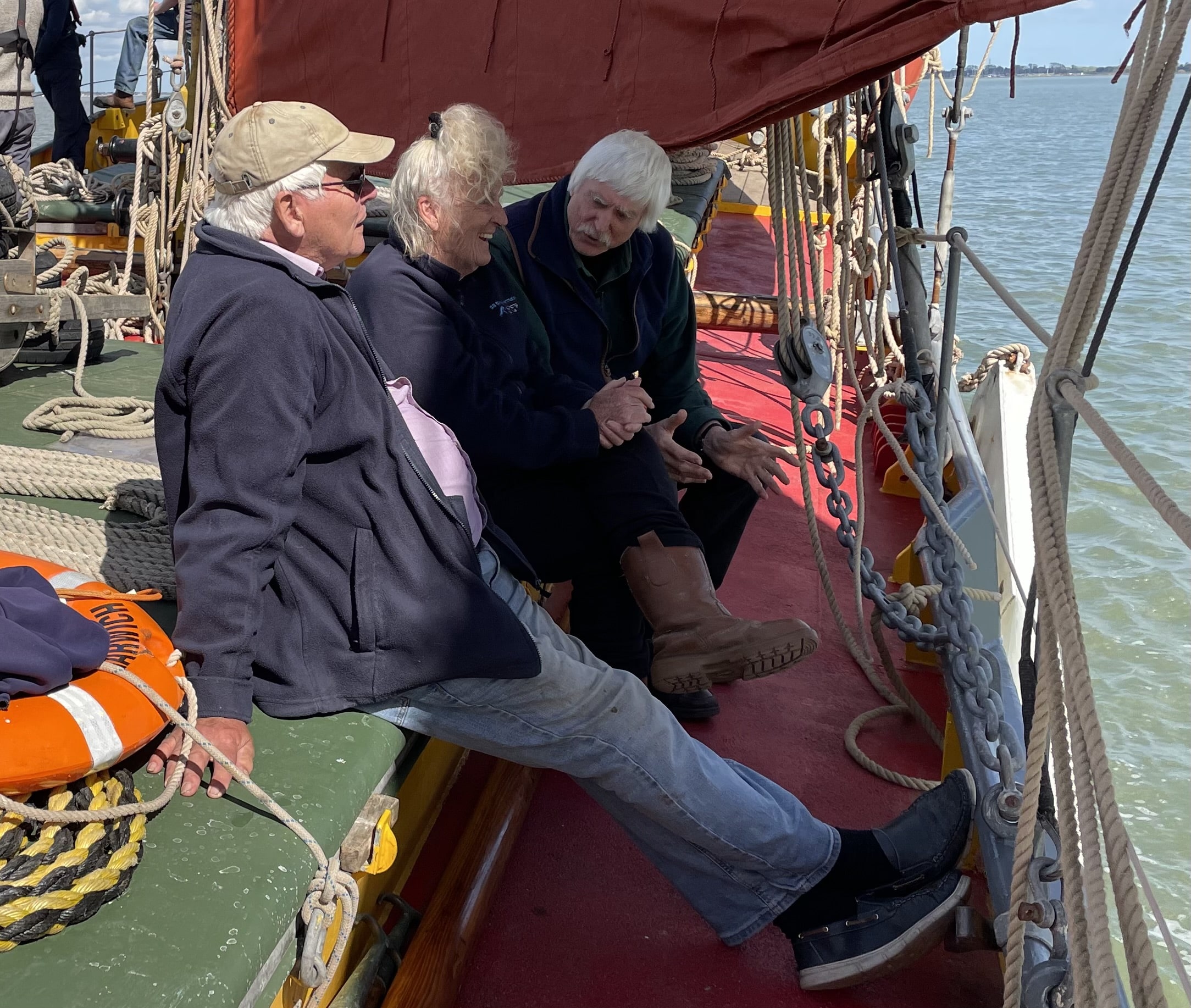
Tom Cunliffe and Friends
Last autumn a named storm kicked into touch the planned weekend for Tom and friends to sail on Blue Mermaid. It is surely coincidence but they seem so much more violent and frequent now they have names. Maybe it is because the names make them more memorable. Maybe the sheer daftness of something sounding so friendly like Storm Dave, the sort of storm you might meet in the pub or at the match, turning into the whirling dervish from the seventh level of hell.
This time the weather Gods were on our side, and Nice Northerly Breeze Mildred blew friendly and true with sun, blue sky and clouds that would grace a Simpsons cartoon. So it was that a crew of canny stalwarts mustered at Stebbens Boatyard at Heybridge Basin to sail with Tom this April after a winter’s delay aboard the now six-year-old-old Blue Mermaid. Tom supported the appeal for funds to build her right from the start and it was good to show him the copy of the appeal prospectus we keep aboard from those early days. In it we read the words he contributed: “Anyone working under sail alone soon learns to accept those things that cannot be changed. They also develop the fortitude to alter what can and must be altered. Understanding the difference between the two is a basic key to wisdom which few adults today ever achieve. When a young person steps ashore after discharging a cargo they have personally worked across days and nights of deep water and shoal, they will look up at the towering spars and begin to know their true worth as individuals”. He spoke at the first reception we held aboard Lady Daphne and again summed up what he meant, this time more succinctly, saying “when it’s ebb tide in the Wallet it’s ebb tide in the Wallet and there is nothing you or anyone else can do about it!”. At that stage in the appeal fruition seemed a distant hope. He was one of several who sustained the vision and encouraged the effort. Now he came to take the wheel and see the result in action, if not up Swin with rubbing band awash deep-loaded as hoped at least performing an excellent service to sail training and the human spirit.
Dropping the mooring on the last of the flood, so pointing downriver, it was the work of moments to drop out some mainsail and the topsail sheet and help the barge gather way. Truth to tell, she was already trying to pass her buoy with just the weather vang slacked away and nothing set, such is the windage on a barge’s gear and so useable are its effects. Below Hillypool fleets of Blackwater Sailing Club cadets kindly parted for our passage, managed it seemed by clever use of whistles by the coaches giving not only Tom among us ideas of utilising wordless instructional techniques in the RYA cruising scheme – so much better than giving the coach a megaphone and a bicycle like they do in rowing.

By the time we reached Osea, Sarah’s excellent lunch gave new vigour to crew setting jib and jib topsail and fine progress was made while almost alone in the scene. Since covid fitting out seems later each year and here we are nearing the end of April with many moorings still bereft of boats at Stone and few even in Mersea Quarters.
But the breeze, though fine at times was developing holes and a fickle sense of direction. Remembering Tom’s tidal truisms, a trip all the way round the Bench Head seemed ambitious, so we brought wind abeam and headed across the low way by the Molliette beacon for the Colne. Roused to revenge for this gentle fetch against the ebb into the river, Mildred now saw things differently. Steadying up from the northwest she first sent in a feint attack with a series of increasing gusts setting the topmast nodding and prompting sending down the jib topsail. Next she flew round to the north and back several times while thankfully keeping enough power to provide a challenging but successful foul-tide beat up to East Mersea Stone. The helm found his arms lengthening with each tack – in these cases tiller steering is so much more effective than the hard work of rapidly turning a wheel.
The finely-honed crew made light work of handing the jib and clearing away bobstay and catted anchor ready for bringing up. But even now Fickle Breeze Mildred had surprises in store. As we came round the final time ready to reduce sail and anchor, she threw a massive shift at us necessitating another pair of tacks before we finally came to rest as planned just on the Brightlingsea side. Thankfully, the river was almost empty for these manoeuvres. To think, we used to do this weaving through as many as five or more anchored ships waiting to go up to the wharves of Colchester, Rowhedge and Wivenhoe with sand barges and fishing vessels adding to the scene. We noted how over the winter the mud by the “wreck” buoy has grown further north as the nearby Stone has too and it is now almost at the buoy. This is worth noting if you are in the habit of keeping up to the buoy as you approach to anchor in the Pyefleet in a southwesterly. Not many now remember the wreck of the SS Lowlands from WW1. Dick Durham tells of when he was in Cambria she cast the wrong way getting the anchor and lay pinned alongside the wreck. A passing motorboat offered a tow for cash and Bob Roberts pleaded poverty only to find his youthful mate spoilt the negotiation entirely by mentioning he had a fiver in his pocket. When a boy, you could row round the wreck at low water and the speed limit notice was at the end of East Mersea Stone. Now the wreck is under the mud and the end of the beach 150 yards from the notice.
Low water Sunday was 0800 and in fear of Mildred again playing games, we mustered early to find a nice northerly and clear blue skies. This time going the deep-water route via the Bench Head recognising how the low ebb brought several lumps of the Molliette on show, there was enough wind to make for some hard winching bringing the barge on the wind. I noted how much better our first-time helmsman did today compared to my own first attempt some forty years ago spent hereabouts in irons for minutes of flapping embarrassment. Mind you, that was not in Blue Mermaid, a paragon for control when clean. It was a perfect barge’s breeze; enough for a bit of sun-soaked spray from time to time but not too much for the topsail, showing off as only a Thames barge can her sense of power and poise capable of sharing by a small crew.
Anchoring close under Osea beach for elevenses, the jib topsail went back in its bag while the jib stayed stowed on the steeved bowsprit ready for the youth charter the next day. Fortified by a lovely lunch at the table, the crew made light work of recovering the anchor and setting gear under the lee before embarking on the many short tacks up the final reaches to the mooring. Now all thoughts of an empty river were out of mind as the excellent Blackwater Sailing Club cadets sent afloat not one, not two but three fleets of dinghies, each well-organised and marshalled with rescue boats in diligent attendance. Approaching the mooring against the flood and to windward is the most taxing scenario, more so with some traffic about. The helpful skipper of the outbound Thistle noted well the situation and stayed close to the moorings on the Heybridge side giving us room to wind and take a favourable position to approach reducing sail gradually to achieve a clean pick up. This is something the spritsail rig lends itself to so well – the balance is retained so much better than any other rig save perhaps an oyster smack working a laying sideways with scandalised mainsail and jib down or barque or full-rigged ship where there are also many options. To be fair, not many square riggers manoeuvre in close quarters under sail these days, although I remember reading of one of Erikson’s departing the pier in the Spenser Gulf under sail as no tug was available. The wind was off and the right combination of sail setting kept the effort of the rig balanced in tune with the need for directional control. In the same way, but in reverse we picked up half the mainsail, making her light-headed. Dropping the foresail rectified that and the mizzen helped throughout of course. The mainsail then up to the sprit brought all the drive into the centre. Slowing more needed the head of the topsail down, but still its sheet added drive above the mainsail, both over the centre of lateral resistance above the leeboard. Finally, with enough way to make the mooring, down came the topsail sheet and up went the mainsail. Now head to wind and moored, the mizzen could be stowed too.
Tidy and shipshape and ready for boats ashore it was time to break the bond of fellowship forged in a few hours in the way only a crew united by the shared relationship to a sailing ship can achieve. On this occasion it was also through one with Tom, for which we were all thankful.